Introduction to Precooling
Soil and climate:
The most efficient method to control the ripening of fruits and vegetables is to remove their field heat almost immediately after harvesting. The removal of field heat is known as precooling. Precooling is the first operation in the cold chain and is essential for produce (fruits and vegetables) as they are perishable in nature.
According to National council for economic research the post harvest losses of commercial fruit and vegetable is almost upto 30%. It amounts to saying that farming community is losing almost Rs.23,000 crores annually.
The main beneficiary of precooling is the grower as it allows him to sell the produce at the most appropriate time and at the competitive price. Consumers and general economy also benefit through adoption of proper post harvest handling procedures through improved shelf quality, lower real costs for fruits and vegetables through the reduction of losses and spoilage.
There is considerable demand for fruits and vegetables in the domestic market and abroad. India, being the second largest producer of fruits and vegetables has the potential to minimize the post harvest losses by adopting proper post harvest technology.
Realizing this, the Ministry of Human Resources Development Government of India entrusted a project to develop a mobile and a stationary precoolers to Indian Institute of Science and Rinac India Limited, Bangalore. Both the precoolers are designed and developed using indigenous technology to suit Indian conditions.
Bio-Chemical Effects
Fruits and vegetables are living organisms that even after harvesting have active metabolism. In addition to respiration heat, certain metabolic by-products such as carbonic acid, ethylene gas are released during the storage causing accelerated ripening with undesirable consequences to the quality.
All the undesirable effects are temperature dependant, higher the temperature larger the damage and culminates in product quality degradation and shortening of shelf life.
The high harvest temperature causes:
* Higher metabolic activity which results in rapid product ripening or aging
* Increased moisture loss causing product drying and shriveling.
* Increased growth of microorganisms causing decay of the products.
It is observed that, precooling of fruits and vegetables should be started within two hours of their harvest. Therefore, by quick and uniform cooling of products after harvesting and subsequently maintaining of the products at optimum temperature, the metabolic process is largely inactivated and the products are brought to a dormant condition. Hence products can be stored for a longer period without losing its freshness, flavour, colour and taste.
Method of Precooling
Fruits and vegetables can be precooled by any one of the following methods.
1. Vacuum cooling
2. Forced air cooling
3. Hydrocooling
4. Hydrair cooling
Each of the above methods has its own advantages, disadvantages, suitability or otherwise to a particular product. Invariably forced air cooling or wet air cooling can be used for precooling of all types of products as it offers the following advantages -
- Simple and economical.
Relatively short precooling time as products are cooled rapidly through direct contact with cold humid air.
Minimum moisture loss because high relative humidity cold air passes over fresh products.
Products retains original in colour, taste, flavour and quality.
Mobile & Stationary Precooler
Quick and uniform cooling to storage temperature of fruits and vegetables within 2 hrs of harvest can increase the storage life, quality and value of the products substantially.
Using the technology from Indian Institute of Science, Bangalore, under the Govt. of India, Technology Development Mission, Rinac has introduced mobile and stationary precoolers for cooling of horticultural products at the farm level.
Rinac's range includes mobile pre-cooler which can be hauled from one place to other, and stationary precooler to be located at a common point.
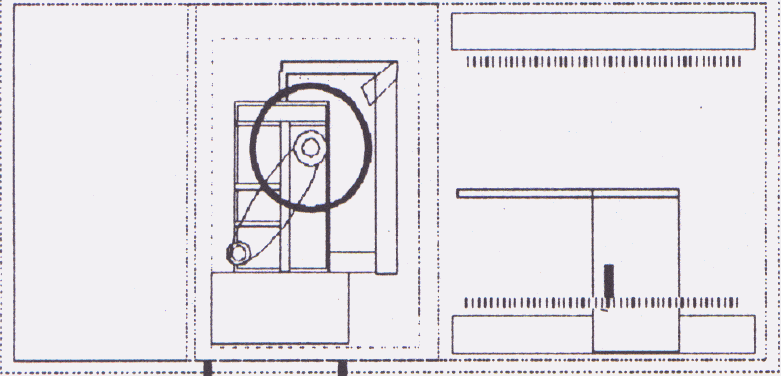
Stationary
Precooler
Salient features of Rinac Precoolers are: -
* Rapid cooling of products
* Specially designed air flow path for uniform cooling
* Controlled high relative humidity
* Full power back up in mobile units
* Multi method precooling option in stationery units.
* Thermal storage facility to meet instantaneous peak load requirement
* Optional trailer mounted mobile units.
Mobile Precoolers
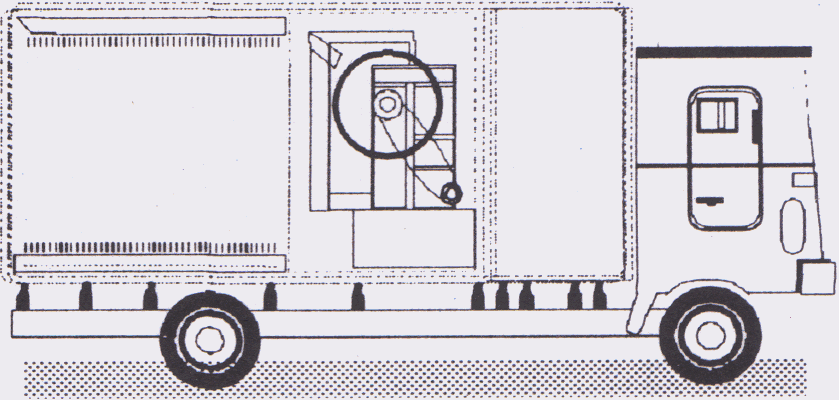
A mobile precooler is one which removes the field heat at the farm and during transit period and thus essentially consists of captive power unit, suitable refrigeration system and air distribution -system and thermal storage as optional, all mounted on a chasis of mobile unit.
Why mobile precooler?
- Need to carry out precooling within 2 hours of harvest.
- Small and co-operative society may not have facility in the near vicinity to the farm for carrying out precooling process.
- Fruits, vegetables and flowers are seasonal hence the requirement of precooling may shift from one place to other.
Under above Indian conditions there is a need for mobile precooler having a capacity of one metric ton of product per batch which can be located / relocated from farm to farm and one place to other depending upon the harvest plan and needs of small/ medium farm or co-operative society.
Mobile precooler can be mounted on a skid/trailer and can be moved using trailer/truck as prime mover.
Hence, to meet the requirement of Indian fanning community, a mobile precooler having a storage capacity of I to 1.5 MT has been designed and developed.
Precooling Time
The approximate precooling time required using mobile precooler for select products is given below:
S
N |
PRODUCTS |
PRECOOLING
TIME |
INITIAL
TEMP (0C) |
FINAL
TEMP (0C) |
1 |
Cut
Flowers |
1HR |
30 |
4.5 |
2 |
Grapes
|
1HR |
30 |
5 |
3 |
Mangoes
|
2HR |
30 |
12 |
4 |
Cucumber
|
1HR |
30 |
8 |
5 |
Strawberries
|
1HR |
30 |
5 |
6 |
Chilies |
2HR |
30 |
5 |
Cost/Benefit of Mobile Precoolers
Example: Grapes precooling
Precooling capacity per batch : 1000 Kg.
Total cost os grapes per batch : Rs. 10,000/-
Cost of consumables
* Hours of generator operation per batch : 5 hrs.
* Total running cost on generator per batch : Rs.250/-, at Rs. 50 per running hour.
* Labour cost for loading and unloading the grapes ( Rs. I per crate) : Rs. 140/-
* Incidental maintenance cost per batch : Rs. 4
Maximum cost of precooling per batch :25+140+4=Rs. 394/-
Maximum cost of precooling per Kg :Rs.0.394 - 40paiseonly
Benefits
3 Product wastage avoided per batch = 20% = 200 Kgs
3 Equivalentcostof200Kgofgrapes =200xl0=Rs2000
3 Minimum net saving per batch = 2000-400 = RS. 1600/-
Investment cost on mobile precooler
* Generator (captive in built) : Rs. 2 lakhs
* Air handling unit : Rs. 2 lakhs
* Refrigeration system : Rs. 2 lakhs
* Insulation & miscellaneous items : Rs. 5 lakhs
* Trailer : Rs. 2 lakhs
Total : Rs 13 lakh
Payback period
* Number of batches per day : 2
* Number of batches per year : 360 (Assuming use of only 6 months in a year)
* Total net saving per year : 1600 x 360 =Rs. 5,76,000 per year
Pay back period is less than two years including the interest on capital investment.
* Life of the precooler : 12 to 15 years
* Total profit during life span (excluding the first two years) : 56 lakhs to 73 lakhs
Other benefits
1. Increase in shelf-life, quality and product value.
2. Decrease in the capacity of refrigeration system of the subsequent cold storage and results in lower initial investment on the cold storage.
Stationary Precooler
The term "precooling " implies the removal of heat before tlie product is transported to a distant market, processed or stored. Some products are room cooled at the same room in which they are stored. In this case, cooling is accomplished over a day or more. Precooling is gradually done in a separate facility within two hours or even minutes. The room cooling is not considered' "Precooling".
The principal methods of precooling are hydrocooling, forced air cooling, hydrair cooling packaging and vacuum cooling. Most cooling is done at the packaging centres. Some products can be cooled by any of their methods without suffering any or adverse effects.
Commercial Hydro cooling
Because of simplicity, economy and effectiveness hydro cooling is a popular precooling method. When a film of cold water flows briskly and uniformly over the surface of a warm substance, the surface temperature of the substance becomes essentially equal to that of the water. Rate of internal cooling is limited by the size shape and thermal properties of the substance being cooled.
Peaches, cherries and many vegetables arc successfully hydrocooled, the more important of two are sweet corn. celesy radish and carrots.
Hydrair cooling
Hydrair cooling uses a mixture of refrigerated air and water in Fine mist spray that is circulated around and through stack by convection. It has the advantage of reduced water requirements, and the potential for improved sanitation.
The cooling rates equal to, and in some cases better than, those obtained in conventional hydrocoolers.
Commercial Forced Air cooling
Products can be satisfactorily cooled by air circulated in refrigerated rooms adapted for that purpose, by forcing air through voids of bulk products.
Forced air involves definite stacking patterns and bafting of stacks. Successful use of the method requires a container with vent holes placed in the direction in which the air will move.
Because the cooling air comes in contact with the product being cooled, cooling is much faster than with conventional room cooling. It is observed that forced air cooling usually cools in one fourth to one tenth the time required for conventional room cooling but that it still takes two to three times longer than hydro cooling.
In association with Indian Institute of Science a "three-in-one precooler" has been designed & developed. The precooler can be used as either forced air, hydro or hydrair cooler. This precooler is a boon to the growers of fruits and vegetables as they can precool all types of fruits and vegetables by using suitable cooling method viz. Forced air, hydro or hydrair. The stationary precooler is designed to cool 5 tons of product in 4 Hrs. The precooler can be stationed at a common point near the farms, to facilitate immediate precooling. Because of the uniqueness of multi method cooling the utilisation period of the precooler can be enhanced by cooling vegetables and fruits harvested at different seasons.
Cost/benefit of stationary of precooler.
Example: Grapes precooling.
- Precooling capacity per batch :5000kgs
- Cost of grapes per kg. : Rs 10
- Total cost of grapes per batch :Rs 50,000/-
Cost of Consumables.
- Total power of consumption : 360 KWH
- Cost of power (Rs. 3/KWH) : Rs 360X3=Rs 1080
- Labour cost. maintenance cost per batch : Rs 500/-
Total precooling cost : Rs 1,580/
Precooling cost/kg of grapes : 1580/5000=0.316 paise.
Benefits
* Reduction in product wastage per batch : 20% = 1000 kgs
* Equivalent value for l000Kgs : Rs. 10,000/-
* Minimum net saving per batch : Rs. 10,000 - 1580 = 8420
Investment cost
* Total cost of the precooler for all the three methods of cooling : Rs. 35,00,000/-
Pay back period:
Life of precooler |
15 to 20 yrs |
No. of batches per day |
2 |
Total No of batch per year
(assuming only 6 months in operation) |
360 |
Total saving per year |
360X 8420=3031200 |
Pay back period |
A Little over one year |
Total profit during life span
(excluding the first one year) |
Rs 424 lakhs to Rs 606 lakhs |
Recommended Storage Conditions of Select Fruits & Vegetables
Product |
Storage Temp(0C) |
RH% |
Approx. Storage
Life |
Apples |
-1 to +4 |
90-95 |
3-8 months |
Bananas |
13 to 15 |
85-90 |
1 week |
Grapes |
0 to 1 |
85-90 |
3-6 months |
Mangoes |
10 to 15 |
85-90 |
2-3 weeks |
Cabbages |
0 to 0.25 |
90-95 |
5-6 months |
Cauliflower |
0 to 2 |
90-95 |
2-4 months |
Onions |
0 to 2 |
75-80 |
6-8 months |
Potatoes |
3 to 10 |
85-90 |
6-8 months |
Lime |
9 to 10 |
85-90 |
1-6 months |
Oranges |
0 to 9 |
85-90 |
1-3 months |
Technical Specifications of Precoolers
Description |
Mobile precooler |
Stationary |
Precooler |
|
|
Quantity of product/
batch |
Upto 1500 kg |
Upto 5000kg |
Number of batches/day |
2 |
2 |
Insulation of chamber |
100mm RPUF panels |
100mm RPUF panels |
Refrigeration system
capacity |
10 Kw at -50C
evap.
temp |
90 Kw at 50C |
Evap. temp |
|
|
Thermal storage |
Yes |
Yes |
Power supply
reqmt. |
15 kw,3 Ph |
15
Kw, 3ph |
Back up power DG set |
20 KVA |
Optional |
Final air temp. |
Upto 20C |
Upto -50C |
Cooling time |
1.5 Hrs |
4 Hrs |
