
For Clean, Smart and Profitable Farming.


AgTechNews.com
Crop Cultivation Guidence
SPICES & CONDIMENTS : Coriander Cultivation
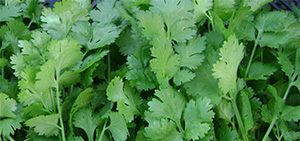
IntroductionCoriander (Coriandrum sativum L.) is an annual herb, mainly cultivated for its fruits as well as for the tender green leaves. It is native of the Mediterranean region. In India, it is grown in Andhra Pradesh, Tamil Nadu, Karnataka, Rajasthan and Madhya Pradesh. Major portion is though consumed locally; a small quantity is being exported now. |
 |
The fruits have a fragrant odour and pleasant aromatic taste. The odour and taste are due to the essential oil content, which varies from 0.1 to 1.0 % in the dry seeds. These essential oils are used for flavouring liquors, coca preparations in confectionary and also to mask the offensive odours in pharmaceutical preparations. | |
The dried ground fruits are the major ingredients of the curry powder. The whole fruits are also used to flavour foods like pickles, sauces and confectionary. The young plants as well as the leaves are used in the preparation of chutney and are also used as seasonings in curries, soups, sauces and chutneys. It has medicinal properties too. Fruits are said to have carminative, diuretic, tonic, stomachic and aphrodisiac properties. |
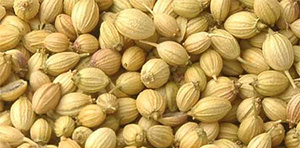 |
Coriander belongs to the family Apiaceae. It is a smooth, erect annual herb 30 to 70 cm high, lower leaves broad with crenately lobed margins, upper leaves finely cut with lineary lobes, flowers small, white or pink in compound terminal umbels, fruits – schizocarp, globular, yellow-brown, ribbed, 2 seeds, ripe seeds are aromatic. | |
Climate and Soil
It is a tropical crop and can be grown throughout the year (except very hot season i.e. March-May) for leaf purpose, but for higher grain yield it has to be grown in specific season. A dry and cold weather free from frost especially during flowering and fruit setting stage favours good grain production. Cloudy weather during flowering and fruiting stage favours pest and disease incidences. Heavy rain affects the crop. As an irrigated crop, it can be cultivated on almost all types of soils provided sufficient organic matter is applied. Black cotton soils with high retentivity of moisture is best under rainfed conditions.
Varieties
Many improved varieties of coriander are now available for cultivation in Tamil Nadu, Andhra Pradesh, Gujarat and Rajasthan states.
| Variety | Parentage | Characteristics |
|---|---|---|
| CO1 | A pure line selection | Released by TANU, Coimbatore. Tall plant, many umbels per plant, suitable for green and grains. Duration 110 days. Yield 500kg per ha. |
| CO2 | A reselection from culture P2 of Gujarat | Released by TANU, Coimbatore. High yield, dual purpose variety, tolerant to drought, oil 0.3%. Duration 90-110 days. Yield 600-700kg per ha. |
| CO3 | Reselection from Acc. No. 695 | Released by TANU, Coimbatore. High yield, dual purpose, medium size grain, seed oil 0.38-0.41%. Duration 103 days. Yield 640kg per ha. |
| Gujarat Corinader-1 | A selection from local | Released by GAU, Jagudan. High yield, more number of branches, seeds bolder and greenish in colour. Duration 112 days. Yield 1100kg per ha. |
| Gujarat Coriander-2 | A selection from CO2 | Released by GAU, Jagudan. High yield, more branches, dense, foliage, umbels large size, grain purpose variety, bold seeds, no lodging. Duration 110-115 days. Yield 1500kg per ha. |
| Rajendra Swati | A mass selection from germplasm type | Released by RAU, Dholi. High yield potential, suitable for intercropping, fine seeded, rich in essential oil, resistant to stem gall disease. Duration 110 days. Yield 1200-1400kg per ha. |
| Rcr-41 | Recurrent selection from UD 41 | Released by RAU, Jobner. High yield, tall erect, suitable for irrigated areas, resistant to stem gall. Duration 130-140 days. Yield 1200kg per ha. |
| Swati | Mass selection | Released by APAU, Guntur. High yield, semi erect, suitable for delayed sowing. Duration 80-90 days. Yield 885kg per ha. |
| Sadhana | Mass selection | Released by APAU, Guntur. High yield, suitable for rainfed areas, semi erect, resistant to aphid and mites. Duration 95-105 days. Yield 1000kg per ha. |
Land preparation
For raising a rainfed crop, the land is ploughed 3 to 4 times following rains and field must be planted immediately to break the clods and to avoid soil moisture. For irrigated crop the land is ploughed twice or thrice and beds and channels are formed.
Sowing
In the North and Central parts of India and Andhra Pradesh, it is mostly grown as a Rabi season crop and
hence sowing is done between middle of October and middle of November. In certain pockets
of the above area, late kharif crop is sometimes sown in August-September. In Tamil Nadu,
as an irrigated crop, coriander is raised in June-July and September-October. In the first
season, the crop matures late with an extended growth phase during January-February. The
growth and the yield rainfed conditions, it is sown during September-October, at the onset
of Northeast monsoon and harvested during January-February.
A seed rate of 10 to
15 kg per hectare is required. Seeds stored for 15 to 30 days record better and early
germination than freshly harvested seeds. Seeds soaked in water for 12 to 24 hours before
sowing also enhances better germination. The seeds are split into two halves by rubbing
and generally done in rows spaced at 30 to 40 cm apart with 15 cm between hills. Soil
depth should not exceed 3.0 cm. Three to five seeds are sown in seeds are broadcast and
covered with country plough. Germination takes place in 10 to 15 days.
Manures and fertilisers
About 10 tonnes of farmyard manure is applied at the time of last preparation. In addition, the following fertilizers may be applied.
| Name | N | P | K | |
|---|---|---|---|---|
| Basal | 30 days after sowing | Basal | Basal | |
| Irrigated crop | 15 | 15 | 40 | 20 |
| Rainfed crop | 20 | - | 30 | 20 |
Irrigation
First irrigation is given 3 days after sowing and thereafter at 10 to 15 days interval depending upon the soil moisture available in the soil.
Interculturing
The first hoeing and weeding and weeding are given in about 30 days. Thinning the plants is also attended simultaneously, leaving only two plants per hill. Depending upon the growth one or two more weeding are done.
Harvesting and yield
The crop will be ready for harvest in about 90 to 110 days depending upon the varieties and growing season. Harvesting has to be done when the fruits are fully ripe and start changing from green to brown colour. Delaying of the harvest should be avoided lest shattering during harvest and splitting of the fruits in subsequent processing operations. The plants are cut or pulled and poled into small stacks in the field to beating with sticks or rubbing with hands. The produce is winnowed, cleaned and dried in partial shade. After drying, the produce is stored in gunny bags lined with paper. The rainfed crop yields on an average 400 to 500 kg/ha and the irrigated crop 600 to 1200kg/ha.
Plant protection
At the seedling stage coriander is often attacked by the leaf eating caterpillars and semi-loopers and at the
flowering stage by the aphids. Spraying the crop with methyl demeton (0.05%) is
recommended to control the aphids but a flowering stage the use of any insecticide would
kill the bee population affecting pollination in the crop.
Powdery mildew (Erysiphe
polygoni) is a serious disease, which ruin the crop if allowed unchecked in the
initial stage itself. Spraying wettable sulphur 0.25% or 0.2% solution of Karathane twice
at 10 to 15 days interval is recommended. Grain mould is caused by Helminthosporium
sp., Alternaria sp., Carvularia sp. and Fusarium sp. It can be
controlled by spraying carbendazim 0.1% 20 days after grain set.
